
The Machine That Thinks in Parallel
Quantum computing is no longer a physics experiment. It is an industry, and for anyone in finance or crypto, a countdown clock


Every machine you have used, your laptop, your phone, operates on the same fundamental principle invented in the 1940s. Information is stored as bits, tiny switches that are either on or off, representing 0 or 1. Complex computations are enormous chains of these switches flipping in sequence, one after another, billions of times per second.
For most tasks, this is fine. Sending emails, streaming video, executing trades, sequential processing handles all of it. But there is a class of problems where sequential processing runs into a wall. Designing a new drug molecule requires simulating how thousands of atoms interact simultaneously. Optimizing a global shipping network means evaluating trillions of possible route combinations. Modelling how a financial crisis propagates through interconnected markets requires capturing correlated risks that do not reveal themselves one variable at a time.
For these problems, classical computers do not fail, they just take so long that they become practically useless. This is exactly the gap quantum computing was designed to fill.
Understanding The Basics of Quantum Computing
To understand what quantum computing is, you first need to understand what they are not. They are not simply faster classical computers. They are a completely different kind of machine, one that processes information in a fundamentally different way, which makes it capable of solving problems that classical computers cannot touch, no matter how much processing power you throw at them. To understand why, let’s break it down piece by piece.
The bit and qubit
Every classical computer stores all information as bits. A bit is the smallest unit of information, and it can only ever be one of two things: a 0 or a 1. Every photo, every email is ultimately just a very long string of 0s and 1s, worked through sequentially, one operation at a time.
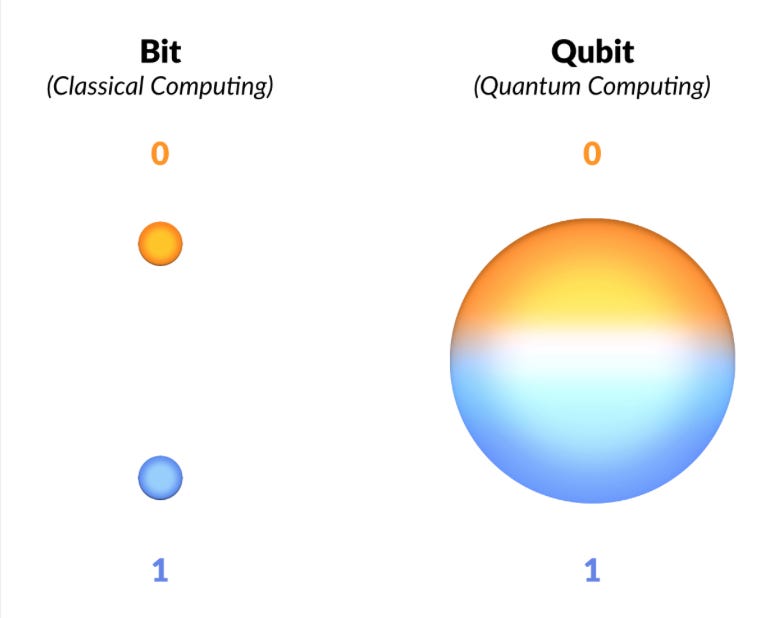
Quantum computers use qubits instead. A qubit can be a 0, a 1, or crucially both at the same time. This is called superposition, and it’s a real physical property that comes directly from quantum mechanics. A qubit does not choose whether it is a 0 or 1 until the moment it is measured. Before that, it genuinely exists in both states simultaneously.
To see why this matters, consider what happens with just three bits versus three qubits. Three classical bits can represent eight possible combinations - 000, 001, 010, all the way to 111. But at any given moment, they can only hold one of those eight. A computer working through this has to pick a state, work with it, then move to the next. Three qubits, by contrast, hold all eight combinations at the same time, the computer is not picking one path and following it, it is processing every path simultaneously.
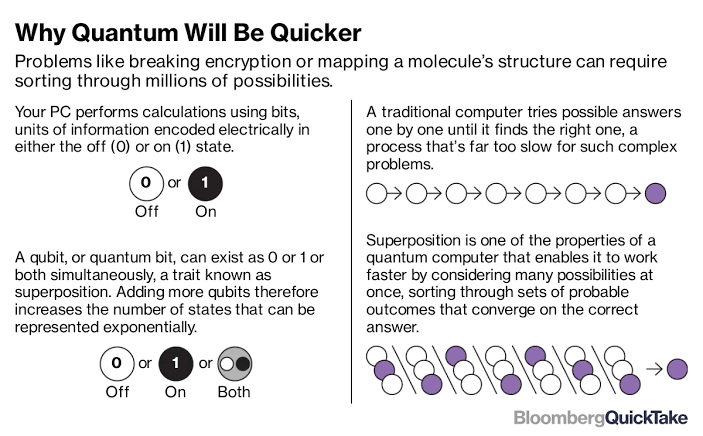
This is why the capacity gap does not grow by adding, it grows by doubling with every qubit. By the time you reach 300 qubits, the number of states being processed simultaneously exceeds the number of atoms in the observable universe. A classical computer could never catch up by simply running faster, because the difference is not one of speed, it is one of structure.
How a Quantum Computer Actually Returns an Answer
Superposition creates an obvious problem. If a quantum computer is processing every possible answer at once, how does it ever give you one specific, correct answer rather than all of them at the same time?
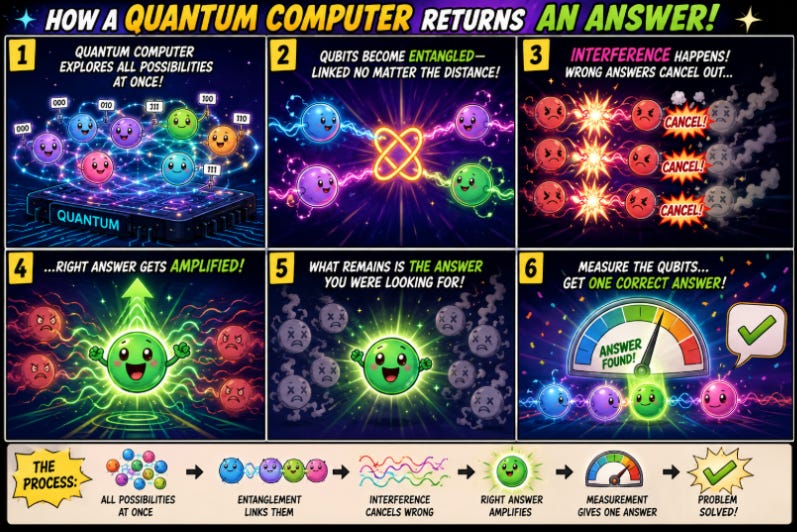
This is where the second fundamental property of quantum mechanics comes in: entanglement. When qubits are entangled, they are physically linked, changing the state of one instantly affects the others, regardless of how far apart they are. A quantum algorithm is designed to exploit this linkage in a precise way. As the computation runs, the entanglement between qubits causes incorrect answers to interfere with each other and cancel out, while the correct answer get reinforced and amplified. By the time the computation ends, the wrong answers have destroyed each other, and what remains is the result you were looking for. This process is called coherence. It is mechanism that makes quantum computing useful rather than just theoretically interesting. Without it, superposition would just produce noise.
What Qubits are Actually Made Of
Qubits are not an abstract concept, they are physical objects, and building them is one of the hardest engineering challenges in modern science. In theory, any particle that obeys quantum mechanical rules can be used as a qubit. In practice, the leading approaches each come with their own extreme requirements.
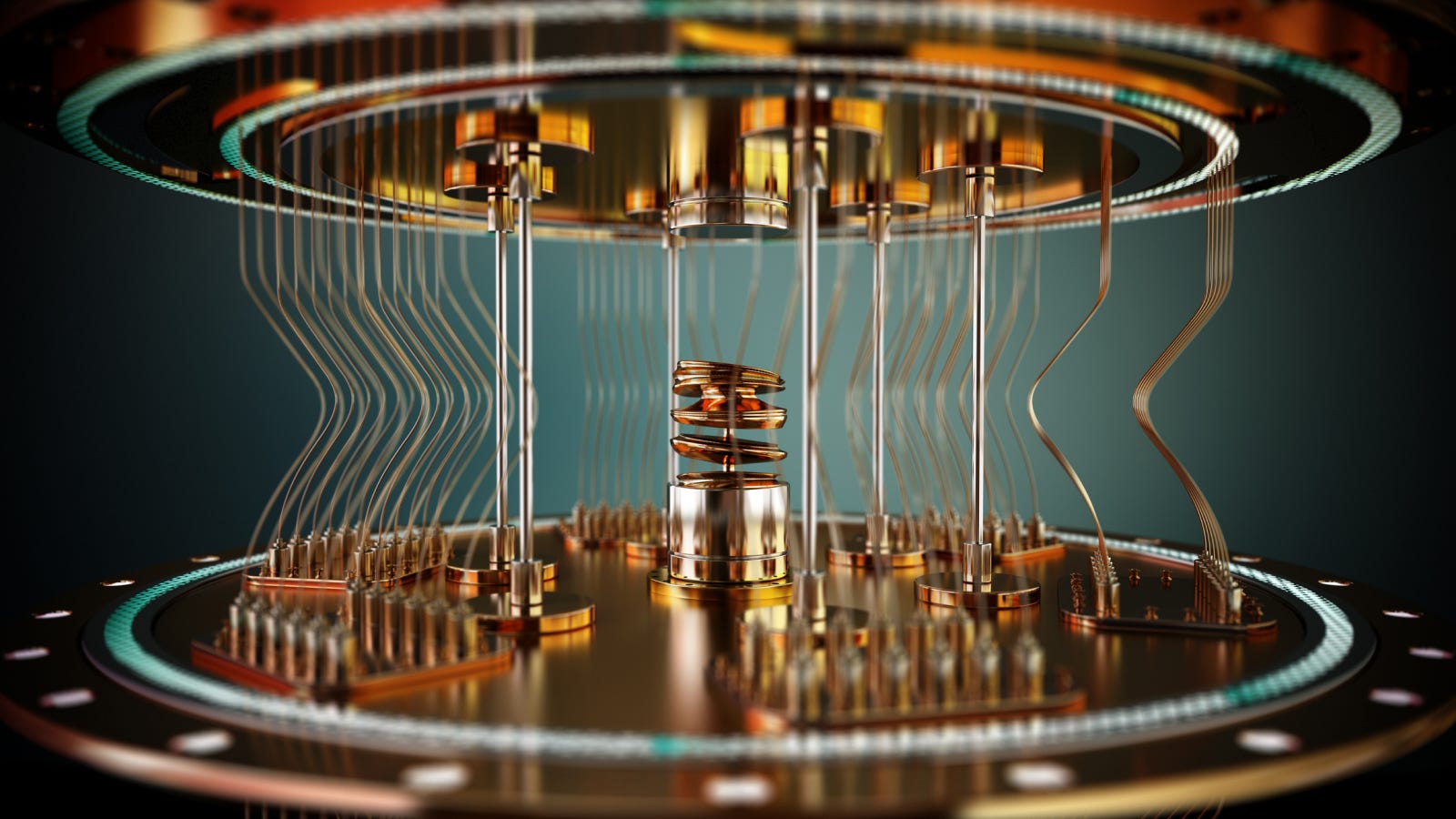
IBM, Google, and D-Wave build their qubits from tiny loops of superconducting wire. These systems need to operate at around 15 millikelvin (colder than the vacuum of outer space), because at that temperature, electrons flow without resistance and the quantum states can be maintained. A stray vibration, a tiny fluctuation in temperature, or a passing electromagnetic signal is enough to destroy the qubit’s quantum state entirely. This sensitivity is called decoherence.
Where Quantum Computing Stands Today
To understand where things stand, it helps to separate what has been solved from what has not.
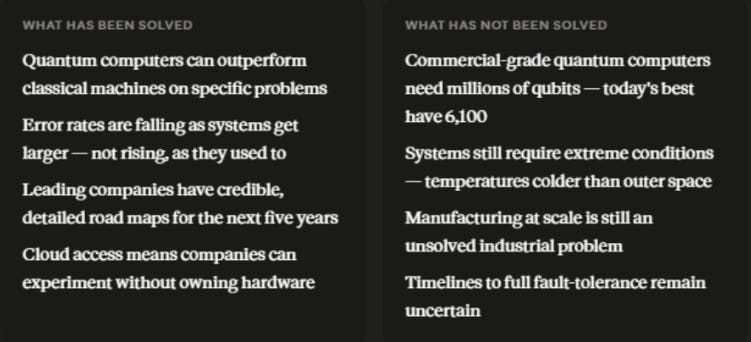
The single most important recent development is Google’s Willow chip. Before Willow, every quantum system ever built shared the same fundamental flaw: the more qubits you added, the more errors accumulated. Willow broke this pattern. For the first time, error rates actually fell as more qubits were added. That might sound like a technical detail, but it changes everything about the field’s trajectory. It means that building a large, reliable quantum computer is now a question of engineering effort and investment, not a question of whether physics allows it. It does.

The remaining obstacles are different kind of problem. They are not about discovering new physics, they are about building industrial scale infrastructure. Quantum computers need extremely precise layers, refrigeration systems that operate near absolutely zero, and specialized electronics that do not yet exist at the volumes needed. These are supply chain and manufacturing challenges. They are difficult, but they are the same category of problem that semiconductor industry solved over fifty years of steady engineering process.
Where Quantum Is Creating Value Right Now
The most important shift in the quantum computing story right now is not a technical one. It is a behavioral one. Companies are no longer just running experiments to see what quantum computers can do. They are starting to embed quantum into actual business workflows.
McKinsey analyzed 162 companies actively working with quantum computing in detail. What they found is that the early movers are not waiting for the technology to be perfect. They are identifying the specific problems where quantum already outperforms classical methods and deploying it there, while keeping the rest of their operations on classical infrastructure.
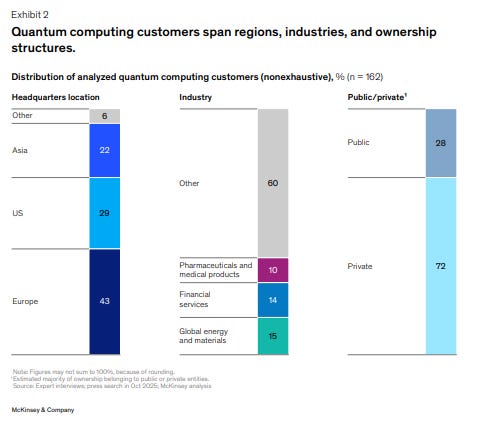
What is perhaps most surprising about the geographic breakdown is who is leading. Of the 162 companies McKinsey analyzed, 43% are headquartered in Europe, compared to 29% in the US and 22% in Asia. This runs counter to the usual assumption that the US dominates every major technology wave. The explanation is a combination of strong government R&D support across Germany, France, and aggressive early adoption by large European companies.
That last number matters in a different way too. A few years ago, quantum computing budgets were almost entirely in the hands of governments and research institutions. Today, private companies account for 72% of quantum computing use worldwide, a complete reversal from even three years ago. The technology has crossed from scientific curiosity into commercial R&D budgets, and the companies committing serious money are doing so because they see a specific ROI, not because they are chasing a trend.
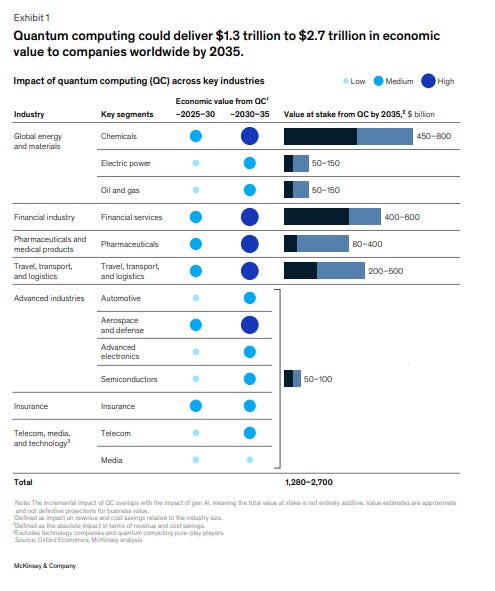
Of all the industries exploring quantum computing, three stand out as the clearest near-term beneficiaries.
Chemicals and life sciences (Value at stake by 2035:$450-800B)
This is the sector where quantum has the clearer near term edge. The underlying problem is molecular simulation, figuring out how atoms and molecules interact. Classical computers solve this by approximating because the exact calculation is too complex. Quantum computers can model these interactions far more directly. In drug discovery, this translates to faster and cheaper early stage screening. Instead of testing thousands of drug candidates in physical lab experiments, quantum algorithms help researchers identify the most promising ones before a single test tube is involved. Companies like Boehringer Ingelheim, Novo Nordisk, and Roche are already doing this.
Travel, transport, and logistics (Value at stake by 2035:$200-500B)
The problem here is combinatorial optimization. Routing a global fleet, airline network schedule, designing a supply chain. Quantum algorithm do not replace the whole system, they are deployed at the specific decision points where the combination problem becomes hardest. Even marginal improvements matter at scale. A 1 to 2% gain in fleet utilization across a global logistics operation translates directly into hundreds of millions of dollars. Exxon Mobil is already working with IBM on quantum-optimized routing for its tanker fleet.
Financial services (Value at stake by 2035: $400-600B)
Of the three sectors leading quantum adoption, financial services is the most complicated, and the most interesting. Quantum computing is simultaneously one of the most powerful tools the industry could gain, and one of the most serious threats it has ever faced. Both sides of story are worth understanding. But they are different enough that they deserve separate treatment. This section is about the upside: how banks are actually using quantum computing today to get better at what they already do. The threat side, Q-Day, encryption, Bitcoin, comes next.
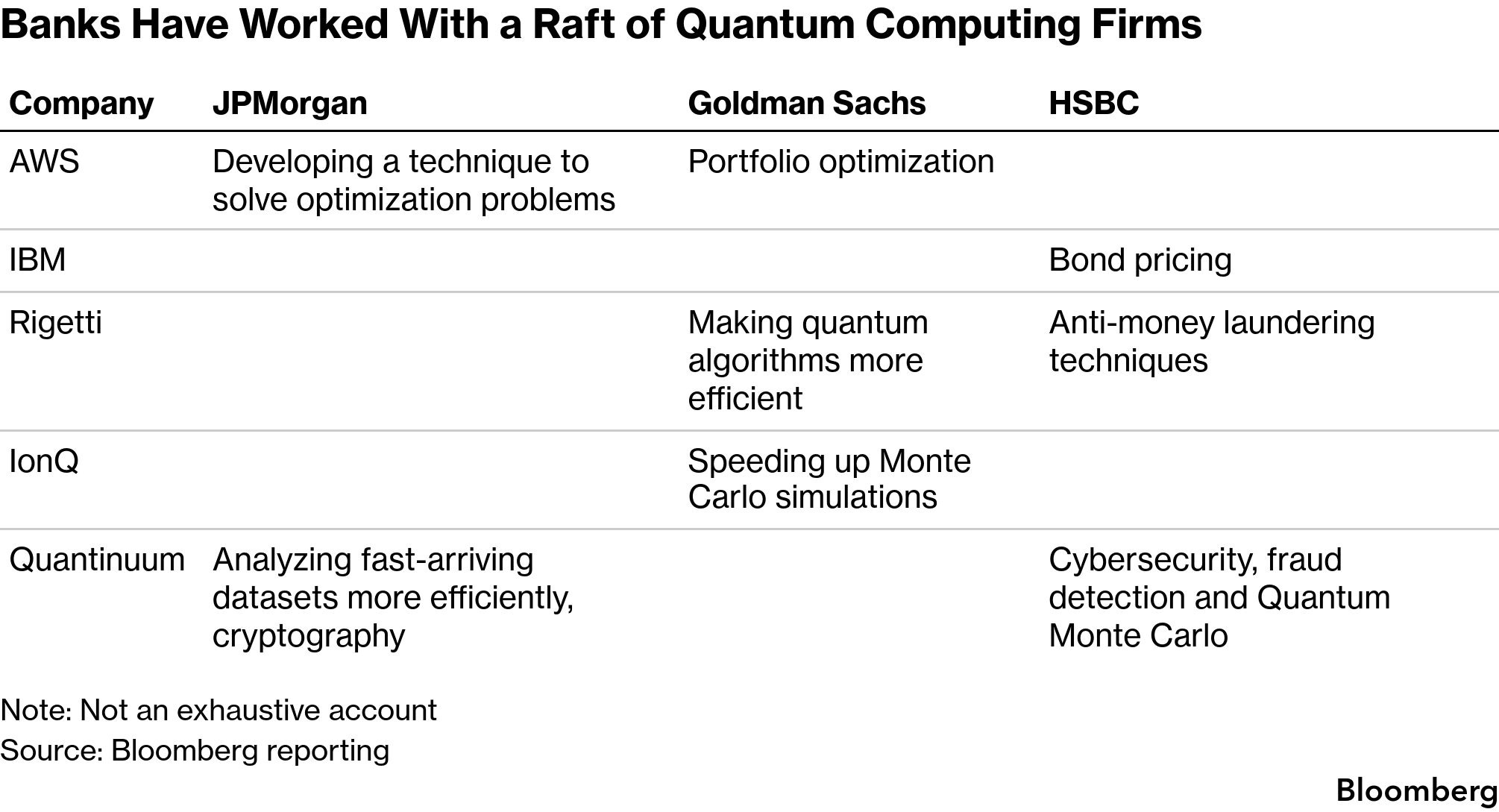
The core appeal is straightforward. The problems quantum computers are built to solve map almost perfectly onto the hardest problems in finance, optimizing portfolios across thousands of correlated assets, modeling complex risk scenarios, detecting fraud in real-time data streams, pricing assets under conditions where the number of possible scenarios is too large for classical models to handle cleanly. Every major bank is dealing with some version of these problems every single day. Quantum offers a materially better way to approach them. The question is not whether the use case exists. It is who moves fast enough to capture it.
The Other Side of The Coin: Q-Day
So far we have talked about what quantum computing can do for finance. Now for the part that keeps security teams awake at night.
Every time you make a bank transfer, log into a financial account, or send Bitcoin, the transaction is secured by public-key cryptography. The security rests on a simple mathematical fact: it is easy to generate a public key from a private key, but practically impossible to reverse the process and find the private key from the public one. That one-way property is what makes the entire system secure. Classical computers, even the most powerful ones ever built, cannot crack it in any practical timeframe.
A quantum computer running an algorithm called Shor’s algorithm changes that entirely. Rather than trying solutions one by one, it evaluates an enormous number of possibilities simultaneously, it’s like brute forcing but on steroids. The encryption does not get harder to break. It effectively disappears as a barrier. This is the scenario the field calls Q-Day: the moment a quantum computer powerful enough to do this actually exists.
How close is it? A Google Quantum AI whitepaper found that breaking the 256-bit elliptic curve cryptography protecting every Bitcoin address and most banking infras requires no more than 1,200 logical qubits and fewer than 500,000 physical qubits. That estimate is roughly 20 times lower than figures that dominated the field five years ago.
Today’s most advanced machines have around 6,100 connected physical qubits. IonQ’s roadmap targets 1,600 logical qubits by 2028. IBM projects 2,000 logical qubits by 2033. The gap is closing on a published, measurable timeline.
What makes Q-Day more urgent than the hardware timeline alone suggest is a concept called “harvest now, decrypt later.” They can intercept and store encrypted financial data today and decrypt it the moment the hardware becomes capable. By most credible assessments, this practice is already happening. The clock did not start at some future date. For anyone whose data is worth collecting, it started already.
Both traditional finance and Bitcoin run on the same underlying cryptography, elliptic curve cryptography, that Q-Day threatens. But the two worlds face that shared threat very differently, and how each responds reveals something fundamental about the difference between centralized and decentralized systems.
How TradFi is adapting?
Traditional finance has a structural advantage here that crypto does not: central authority. Regulators can mandate a migration timeline, and they have.
The starting point is that the technical solution already exists. In 2024, National Institute of Standards and Technology (NIST) finalized the first set of post-quantum cryptographic algorithms. These are not just theoretical proposals. They are published, peer reviewed, and available for deployment right now. The problem is not finding the answer. It is executing the transition at scale.
Government have made the transition non-optional. The U.S. signed executive orders in June 2026 mandating that all high-value federal assets migrate to post-quantum standards by 2031. The NSA has called for quantum-safe systems across critical infrastructure by 2030. The US has also set a deadline for phasing out the elliptic curve cryptography used across most banking systems by 2035. For financial institutions operating under regulatory oversight, these deadlines flow downstream, they set the pace for the entire industry whether individual banks are ready or not.
What makes this genuinely hard is not the technology, it is the scale of what needs to change. Replacing the encryption infrastructure of a large bank means auditing thousands of systems built across decades, updating legacy code with deep dependencies, coordinating with dozens of vendors, and managing the entire transition without disrupting live operations. It is less like a software upgrade and more like rewiring the electrical system of a building while people are still living in it.
How Bitcoin is adapting?
This is a risk that even the most committed Bitcoin maximalists cannot dismiss. Bitcoin’s entire value proposition rests on one promise: the math securing the network is beyond the reach of any attacker. Quantum computing is one technology that could eventually test that promise. The explanation ahead gets a bit technical in places, but we’ll try to keep it as simple as possible. If you want to understand the basics first, how Bitcoin actually works, we’ve previously covered that in our Bitcoin 101 series: Part I, Part II, Part III.
First of all, not all Bitcoin are equally exposed. Some old addresses show their public key openly on the blockchain. A powerful enough quantum computer could theoretically use that visible key to work out the private key and take the coins. Newer address types keep that key hidden until the moment you actually spend, which is the most wallets already use today. So the real exposure is concentrated in old, often dormant coins.
A 2025 Human Rights Foundation report put numbers on this: about 1.72 million Bitcoin (over $115 billion) sits in the most exposed old-format addresses, and another 4.49 million (~$300 billion) is exposed but could still be moved to safety by its owners. Combined, that’s around 31% of all Bitcoin carrying some quantum exposure. The trickiest chunk is the roughly 1 million Bitcoin believed to belong to Satoshi, which can’t be moved since no one holds those keys.
The encouraging part: Bitcoin’s developers didn’t wait for a crisis to start working on this. In February 2026, a proposal called BIP 360 was formally submitted. BIP 360 fixes the “your key sits exposed for years problem”, but not the smaller “your key is briefly exposed for a few minutes while a transaction confirms” problem, that needs a different, newer kind of digital signatures that is still being built. A follow up proposal, BIP 361, goes further and would eventually phase out the old system entirely. Those new signatures are also bulkier, at least 10x bigger than what Bitcoin uses now, which means extra engineering work to keep the network fast. None of this is new territory, Bitcoin has handled big upgrades like this before (like Taproot) without disrupting anyone’s coins.
The harder part is getting everyone to agree, since Bitcoin has no CEO or company setting deadlines, every change needs broad buy-in from a famously change-resistant global community. That’s slower, but changes that do pass tend to be solid and well-tested. If things move steadily from here, full quantum-readiness is estimated at around 7 years: a few years to finalize and test the tech, six months to activate it, and a few more for wallets and exchanges to catch up. Whether that holds really comes down to execution, how much attention this gets from developers, and whether the industry treats it as a priority rather than something to worry about later.
Estimates for how fast a real quantum threat could arrive range widely too, anywhere from 5 years to a couple decades out, depending who you ask, which is genuinely uncertain in both directions. Adam Back of Blockstream has argued a Bitcoin-breaking quantum computer could still be decades away, and it’s true that quantum computers haven’t yet cracked anything close to real-world encryption. That skepticism isn’t unreasonable. But as quantum researcher Scott Aaronson put it: “The time to start thinking about this is now. An even better time would have been yesterday.” It’s less a warning than simple math, preparing early is cheap insurance no matter which timeline turns out right, and BIP 360 shows Bitcoin has already started. Whether that head start is enough comes down to how well it’s executed from here.
Last Question: Is There Money to Be Made Here?
The honest answer: it's complicated, because quantum computing as an investable trade is still mostly a story, not a set of numbers.
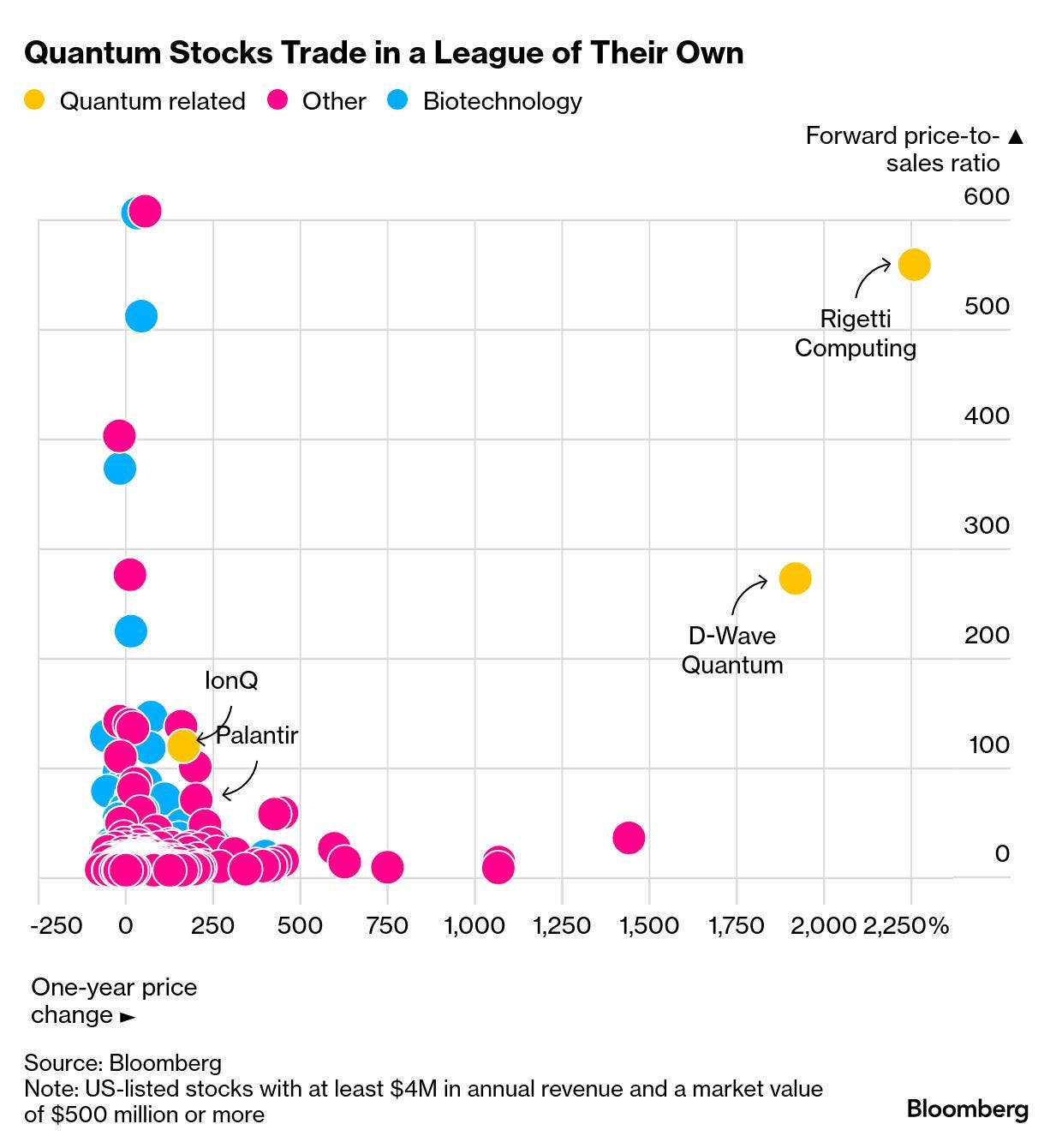
As of late 2025, pure-play quantum stocks had gained over 1,900% in a year, pushing several names past $10 billion in market cap, bigger gains than most of the AI trade over the same period. But that run-up has almost nothing to do with earnings. These companies are still pre-revenue in any meaningful sense, trading at valuations several times higher than even the most expensive AI stocks on the market, priced on the promise of what the technology could eventually do rather than what it’s currently doing. That’s the core issue: quantum computing is still a new, largely unproven concept commercially.
The physics is increasingly validated, but the business case mostly isn’t there yet, which is exactly why skeptics call this a momentum bubble rather than a fundamentals-driven rally, while bulls justify it the same way early biotech bets get justified: a binary outcome where being early either pays off enormously or goes to zero.
So maybe the real question isn’t whether quantum computing is real, the physics settled that argument. The real question is whether you’re buying the technology or buying the hype cycle wearing its name, and right now, most of the money flowing into these stocks can’t tell the difference either. Every speculative mania in history has eventually split into two camps: the people who were early to something genuinely transformative, and the people who were early to a story that never became one, and the uncomfortable truth is that from inside the bubble, both camps look identical. Willow proved the physics works. It said nothing about which of these tickers survives long enough to matter. The market is betting on quantum before quantum has proven it can bet on itself.
Thank you sir for clear explanation 🫰🏻